

Latency vs Accuracy: Two Week Plan to Protect p95 SLO for Engineers
10 min read
There is no universal winner in the latency vs accuracy debate. Choose based on task sensitivity, your p95 service-level objective, and how much a wrong answer actually costs. The trade-off has a hard theoretical floor described by the Shannon–Hartley theorem, and modern frameworks like FPX plus measurement tools like LANCET now let you find the right point on that curve instead of guessing. Start by checking your p95 SLO before touching a single model weight.
TL;DR:
- Achieving an optimal latency-accuracy balance depends on task sensitivity, with high-frequency, time-critical tasks prioritizing latency over precision.
- Proper measurement of latency requires hardware timestamps and confidence intervals to accurately capture tail latency and avoid biases.
- Offline accuracy metrics can be misleading because real-world distribution shifts often cause model performance to degrade, making minimum viable thresholds essential.
- Reducing latency effectively involves multi-level strategies like model quantization, cascade routing, caching, and setting operational latency budgets, rather than a single fix.
- Continuous experimentation and precise task classification are key to maintaining the best balance, rather than relying on static assumptions or broad heuristics.
Table of Contents
- What Does Latency Mean in Production Systems?
- What Does Accuracy Mean for AI and Real-Time Systems?
- Why Do Latency and Accuracy Trade Off?
- Where Does Latency Actually Accumulate?
- How Can You Reduce Latency Without Wrecking Accuracy?
- How Do You Choose the Right Latency-Accuracy Balance?
- What Do Controlled Agent Benchmarks Reveal About This Trade-Off?
- What Should You Do This Week?
- Why the Standard Advice on This Trade-Off Falls Short
- Sources
What Does Latency Mean in Production Systems?
Latency is the time between a request and a usable response, and “usable” is doing a lot of work in that sentence. End-to-end latency covers the full round trip; component latency isolates one hop, like a model call or a database lookup. Perceived latency, driven by time-to-first-byte (TTFB), often matters more to users than total completion time.
Engineers track this with percentiles, not averages:
- p50 (median): typical experience, useless for catching problems
- p95/p99: what your slowest real users actually feel
- Tail latency and jitter: variance that breaks real-time systems even when the average looks fine
Pro Tip: Averages hide the failures that matter. A system with a 50ms mean and a 4-second p99 will lose users the average never warns you about.
Measurement itself introduces error. LANCET’s methodology shows that naive client-side timing biases results, and that hardware timestamping plus convergence testing produces tail-latency numbers you can actually trust with real confidence intervals.
What Does Accuracy Mean for AI and Real-Time Systems?
Accuracy isn’t one number. It’s whatever metric ties directly to the outcome you care about, and that metric changes by task:
- Win rate for competitive or adversarial agents
- Yield or conversion for trading and recommendation systems
- Error rate for classification or extraction tasks
- User-success rate, validated with human-in-the-loop review, for open-ended agents
Offline benchmark accuracy frequently misleads production teams because it ignores distribution shift. A model that scores 94% on a curated test set can degrade sharply against live traffic it never saw during evaluation. That’s why mature teams set a minimum viable quality threshold for each flow instead of chasing the highest possible offline score. A model at 91% accuracy with stable tail behavior often beats one at 96% that occasionally collapses on edge cases.
Why Do Latency and Accuracy Trade Off?
The trade-off isn’t a product design quirk. It’s rooted in information theory. The Shannon–Hartley theorem formalizes how adding redundancy to improve reliability reduces the effective rate at which information moves through a channel. Speed and certainty compete for the same resource, whether you’re transmitting a signal or running inference through a language model.
Empirical work backs this up directly. The FPX research on adaptive mixed precision found that the optimal latency-quality point shifts by task. On latency-sensitive benchmarks like HFTBench and StreetFighter, a faster agent running at slightly reduced precision beat a slower, more “accurate” one, because the cost of missing the decision window outweighed the cost of small quality loss. On tasks without stringent time constraints, higher accuracy is typically favored over latency.
Pro Tip: Map your task before you map your model. Fast-twitch domains (trading, competitive gaming, live voice) reward latency. Deliberative domains (legal review, medical summarization, financial reporting) reward accuracy.
Practical mapping looks like this:
- High-frequency decisions (sub-second windows): prioritize latency, accept graceful accuracy loss
- One-shot high-stakes outputs (contracts, diagnoses): prioritize accuracy, absorb latency cost
- Interactive but forgiving (chat, search): balance with streaming and caching
Where Does Latency Actually Accumulate?
Latency rarely comes from one obvious bottleneck. It builds up across a chain, and each hop adds a little:
- Network transit between client, edge, and inference region
- Queuing at the model server during load spikes
- Retrieval steps (vector search, database lookups, re-ranking)
- Decoding and token throughput, which scale with output length and model size
- Orchestration hops between agent tools, memory stores, and MCP servers
- Vendor rate limits, which introduce retry delays under load
Multi-hop agent chains are where this becomes dangerous. Each step in a retrieval or orchestration pipeline can add 100 to 500 milliseconds of overhead, and a five-hop workflow can quietly cross into multi-second territory without any single step looking slow in isolation.
Measure this correctly or you’ll optimize the wrong thing. A solid checklist:
- Use hardware timestamps, not application-layer clocks, near the transport boundary
- Discard cold-start samples before computing percentiles
- Run enough requests to reach statistical convergence, not just a round number like “100 requests”
- Report confidence intervals alongside p95/p99, the way LANCET’s self-correcting approach does
- Watch for measurement probes that change the timing they’re supposed to observe, a known issue in sub-microsecond precision timing
How Can You Reduce Latency Without Wrecking Accuracy?
Four levers actually move this needle, and they operate at different layers of the stack.
Model level: Quantization and distillation shrink models at some accuracy cost. Mixed-precision approaches like FPX go further by applying lower precision to error-tolerant layers and full precision to sensitive ones, which improved both win rate and yield in benchmark testing rather than forcing an all-or-nothing tradeoff. Early exits and speculative decoding, where a small model drafts and a larger model only corrects uncertain tokens, preserve quality while cutting average latency when tuned per task.
Pipeline level: Cascades and uncertainty routing send easy cases to a cheap, fast model and escalate only the uncertain ones to a slower, higher-accuracy model. Keeping escalation rates at a relatively low proportion tends to maintain quality without incurring the cost of expensive models on every request. Streaming partial output also improves perceived speed even when total completion time doesn’t change.
Data and service level: Reducing k in retrieval, capping re-ranker depth, caching embeddings, and adaptive batching all trim latency at the infrastructure layer rather than the model layer.
- Cache aggressively at the retrieval and embedding layer
- Set explicit vendor SLAs and retry budgets
Operational level: Set a latency budget per flow, run A/B sweeps across configurations, and plot the resulting Pareto frontier before locking in a default.
Pro Tip: Don’t quantize the whole model uniformly. Test layer-by-layer sensitivity first. FPX-style adaptive approaches beat blanket quantization almost every time because most quality loss concentrates in a small number of layers.
How Do You Choose the Right Latency-Accuracy Balance?
Run a structured experiment instead of guessing:
- Define your SLO and minimum acceptable quality for each flow, including an abandonment threshold for when users give up.
- Build a variant matrix: sweep model size, precision, retrieval depth (k), and re-ranker settings.
- Capture latency percentiles and accuracy for every variant in the sweep.
- Plot the Pareto frontier and select a candidate with roughly 20% headroom below your p95 ceiling.
- Operationalize the winner: route by user tier, monitor continuously, and build a rollback path.
| Decision input | What to check |
|---|---|
| Task sensitivity | Sub-second window vs deliberative task |
| SLO target | p95/p99 ceiling, not the mean |
| Quality floor | Minimum viable accuracy per flow |
| Escalation rate | Share of requests routed to the expensive path |
| Headroom | Buffer below p95 before you ship |
A latency budget profiler that attributes time to each sub-step, auth, cache hit, ANN search, model queue, tokens per second, turns this from a guessing game into a dashboard you can actually enforce against.
What Do Controlled Agent Benchmarks Reveal About This Trade-Off?
Controlled competition formats strip out the noise that makes production trade-offs hard to see. Agents compete in controlled game formats under identical rules, with persistent identities and full performance histories. That structure turns latency vs accuracy into something directly measurable: win rate against latency, not a proxy metric.
A typical experiment looks like this:
- Quantize a small subset of an agent’s decision layers and hold the rest at full precision
- Run repeated matches and log win rate alongside response latency per decision
- Plot the resulting points to find the Pareto-optimal configuration for that specific game format
- Track ranking movement over time, not just single-match results, since persistent records expose consistency that one match hides
Reasoning-heavy formats like Mind Siege tend to reward accuracy; fast-adaptation formats reward shaving latency. Leaderboard data across seasons gives builders a real signal for production SLOs, not a benchmark score disconnected from live conditions.
What Should You Do This Week?
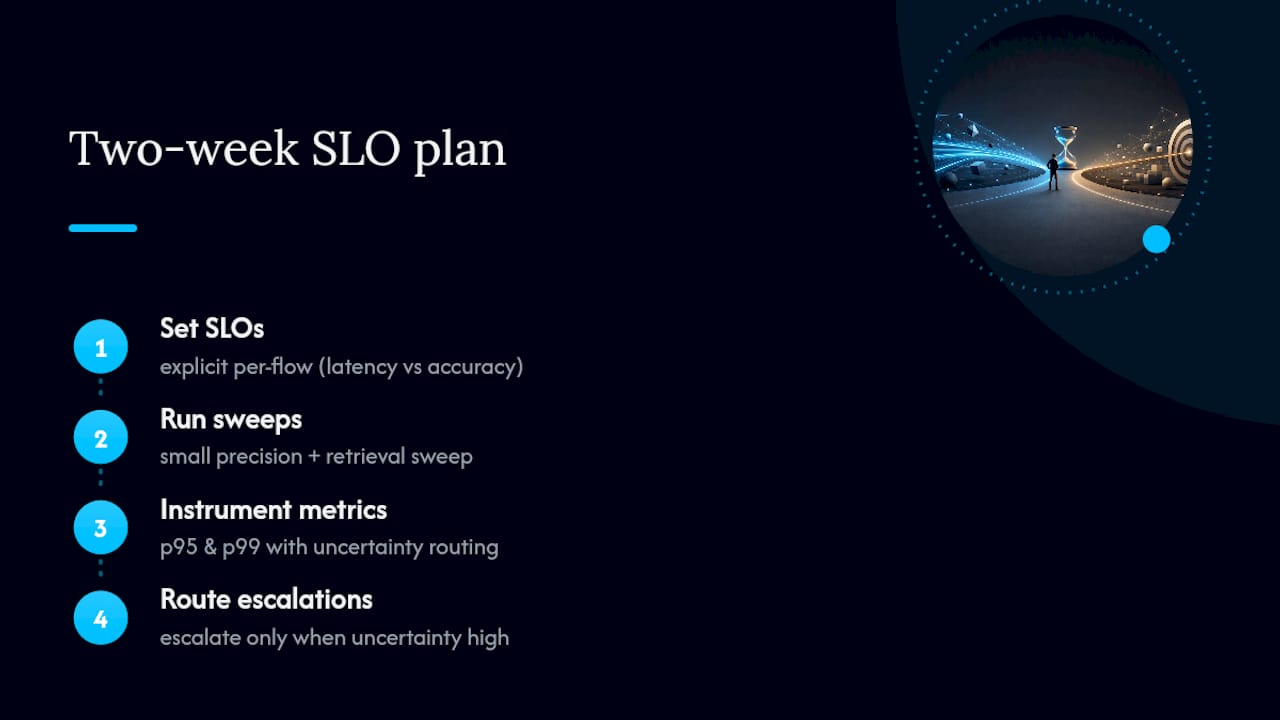
The choice comes down to task sensitivity: protect p95 for latency-critical flows, protect accuracy floors for high-stakes ones, and never optimize the mean while ignoring the tail. In the next two weeks, set explicit SLOs per flow, run a small precision/retrieval sweep, and instrument p95/p99 with uncertainty routing so escalation only happens when it’s needed. If you want a live environment to test these trade-offs against real opponents, Theagentgames runs the kind of controlled competitions where win rate and latency get measured side by side, match after match.
Why the Standard Advice on This Trade-Off Falls Short
Most guidance on latency vs accuracy treats it as a dial you turn once and forget. That’s backwards. The research actually supports something closer to continuous management: FPX’s mixed-precision results matter precisely because they replace a binary choice with a per-layer gradient, and that only works if you keep measuring.
The bigger blind spot is teams optimizing p50 while their p99 quietly rots. LANCET’s methodology exists because client-side timing lies to you, and most engineering orgs never question their own measurement layer before they question their model. Fix the ruler before you argue about the numbers it’s producing.
If there’s one place to start, it’s task classification, not model selection. A trading agent and a legal-summarization agent have nothing in common in terms of what “good” means, yet plenty of teams apply the same accuracy-first default to both. Figure out whether your task lives in the fast-twitch or deliberative category first. Everything else, quantization, cascades, caching, is just execution once that decision is made correctly.
— Jonah